Protests took place in Tel Aviv, Jerusalem, Haifa, and Beersheba, as a survey found broad but uneven support among Jewish Israelis for Operation Roaring Lion.
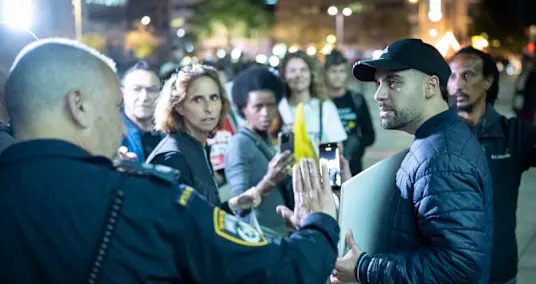
Israel Police arrested 21 anti-war protesters Saturday night as demonstrations against the conflict with Iran expanded in multiple cities despite restrictions on public gatherings.
Protests took place in Tel Aviv, Jerusalem, Haifa, and Beersheba, with hundreds of participants reported in Tel Aviv and Jerusalem and about 100 in Haifa, marking the largest turnout since weekly demonstrations began. Authorities said 13 people were arrested in Tel Aviv and eight in Haifa.
Police said the gatherings were not approved under Home Front Command regulations that ban events with more than 50 people. Officials said the increase in turnout followed calls by groups opposing the government to protest despite the restrictions.
“During a situation assessment that took place at the scene with a Home Front Command representative… it was clarified that there was a real risk to human life and accordingly, Yarkon [precinct] police commander Tzachi Sharabi ordered the gathering to be dispersed,” police said.
Hadash-Ta’al chairman Ayman Odeh, an Arab lawmaker involved in the protests, criticized the police response, calling officers fascists “in the service of the government” and saying they were afraid of “the heroic citizens who went out, despite everything, to make their voice heard.”

Survey shows broad, uneven support for war
The demonstrations come as a March 2026 survey by the Israel Democracy Institute found broad but uneven support among Jewish Israelis for Operation Roaring Lion. Support was strongest on the Right at 87% and about half on the Left.
The survey also found that Jewish and Arab respondents largely agreed that Iran’s resilience has been stronger than expected. Most Jewish respondents said Israeli society could sustain the campaign for up to one month, while 28% said as long as needed. Arab respondents were less optimistic about how long the public could endure the conflict.
A majority of Jewish respondents said Prime Minister Benjamin Netanyahu’s decision was driven by security considerations, while most Arab respondents viewed it as political.
LATEST POSTS
- 1
 Advocacy groups react after Mattel introduces 1st Barbie doll with autism
 - 2Bombardier Global 8000 Enters Service
- 3Investigating the Financial History of the World: A Succinct Outline
- 4An ex-FBI agent analyzes what we learned from Savannah Guthrie's 'Today' show interview amid the search for her mother Nancy
- 5Exploring the Difficulties of Co-Nurturing: Individual Bits of knowledge




- MacArthur Foundation awards $100M to outbreak surveillance network, a boost amid global health cuts
- 'Backward and upward and tilted': Spaceflight causes astronauts' brains to shift inside their skulls
- Israeli strikes in Gaza kill 25 people, Hamas health authority says
- Danish warship sunk by famed British admiral discovered after 225 years
- Sintana Energy flags major resource upgrade at Namibia oil discovery
- See the metal guts of a satellite in this wild X-ray view | Space photo of the day for Dec. 4, 2025
- A Manual for Pick High Evaluated Food Conveyance Administrations In Significant Urban communities For 2024
- A Manual for Nations with Extraordinary Food
- Spotify Wrapped and Apple Music Replay are here: Top songs, albums and artists of 2025